


Healthcare businesses invest heavily in their services, doctors, facilities, and patient care. But these efforts matter less if potential patients cannot find them when searching online for care.
Healthcare PPC helps practices, clinics, hospitals, and other healthcare businesses reach relevant audiences through paid search and digital advertising. Unlike SEO, which takes time to build, PPC can provide faster visibility for priority services and locations.
However, clicks alone do not create patients. Effective campaigns need the right keywords, relevant ads, focused landing pages, accurate tracking, and a clear path from inquiry to appointment.
This complete guide covers what healthcare PPC is, how it works, five effective strategies, common mistakes, costs, and when to use Google Ads or Meta Ads.
What Is Healthcare PPC?
The “pay-per-click” model means you only pay when a patient actively engages with your ad — not for passive impressions. This makes healthcare PPC one of the most measurable, controllable patient acquisition tools available in modern digital marketing.
Healthcare PPC (pay-per-click advertising) is a digital advertising model where hospitals, clinics, and specialist doctors pay a fee each time a potential patient clicks their advertisement. These ads appear at the top of search engine results, on social media platforms, and across display networks — placing your practice in front of patients at the exact moment they are searching for the services you provide.
In 2026, healthcare PPC encompasses several distinct advertising formats — Google Search Ads, Google Local Services Ads (LSAs), Meta Ads (Facebook and Instagram), and YouTube video advertising — each serving a different stage of the patient’s decision journey.
Why Use PPC Advertising for Healthcare?
The case for healthcare PPC is compelling — particularly for practices that cannot wait 6-12 months for SEO to build organic rankings:
- Immediate visibility — a well-structured campaign appears at the top of Google results from day one, above all organic listings and competitor websites
- Intent-based patient acquisition — patients clicking healthcare PPC ads are actively searching for medical services, not passively browsing — making them significantly more likely to book
- Precise audience targeting — geographic radius, specific medical keywords, device type, time of day, and demographic targeting ensure budget reaches the most relevant patients
- Measurable ROI — call tracking, form tracking, and GA4 integration show exactly which campaigns, ads, and keywords are generating actual patient appointments
- Budget control — daily and monthly spend caps prevent unexpected overspend; campaigns can be paused instantly if clinic capacity is full
- Competitive advantage — in crowded urban healthcare markets, PPC advertising lets smaller clinics appear above larger competitors in search results for specific procedure keywords
How Does Healthcare PPC Work?
PPC advertising in healthcare operates through a real-time auction system:
- A patient searches for a medical keyword — “dental implants near me” or “knee replacement surgeon in Delhi”
- Google’s algorithm runs an auction among all advertisers bidding on that keyword
- Your ad’s position is determined by your bid amount multiplied by your Quality Score — not bid alone
- If your ad wins the auction, it appears in the search results — the patient clicks, and you pay the cost-per-click (CPC)
- The patient lands on your designated landing page and takes action — calling, booking, or filling a form
What is Quality Score in healthcare PPC?
Google’s 1-10 rating of your keyword relevance, ad copy quality, and landing page experience. A high Quality Score reduces your cost-per-click and improves your ad position — meaning a well-optimised healthcare PPC campaign consistently outperforms higher-spending competitors with poor optimisation.
Should Healthcare Practices Use Google Ads, Meta Ads, or Both?
This is the most common strategic question healthcare practices ask before investing in PPC advertising.
| Platform | Best For | Patient Intent |
| Google Search Ads | Patients actively searching for a specific procedure or specialist | High — direct appointment intent |
| Google Local Services Ads | Local clinic visibility with Google Screened badge | Very high — pay per verified lead |
| Meta Ads (Facebook/Instagram) | Building awareness for elective procedures (cosmetic, dental, fertility) | Medium — interest-based, not search intent |
| YouTube Ads | Education and trust-building for high-consideration procedures | Low-medium — brand and awareness |
| Google Display/Remarketing | Recapturing patients who visited the website but did not book | Warm — previously engaged audience |
The honest recommendation: Start with Google Search Ads for immediate, high-intent patient acquisition. Add Meta Ads for elective or cosmetic procedures where visual before-and-after content drives consideration. Use remarketing to capture patients who did not convert on their first visit.
5 Proven Healthcare PPC Strategies to Get More Patients
Strategy 1 — Target Procedure-Specific Keywords, Not Generic Terms
The most common and most expensive mistake in healthcare PPC is bidding on broad, generic keywords like “hospital” or “doctor near me.” These terms attract high competition, high cost-per-click, and low conversion rates — because the search intent is too vague to reliably predict appointment intent.
The high-converting approach: Target procedure-specific, intent-rich keywords that tell you exactly what the patient needs and how close they are to booking:
- “dental implant clinic in [city]” — appointment intent
- “knee replacement surgeon in Delhi” — appointment intent
- “emergency eye care Noida” — urgent appointment intent
- “Invisalign cost in [city]” — cost research intent, high conversion when price is transparent on the landing page
Build separate ad groups for each procedure — each with its own tightly matched keywords, dedicated ad copy, and a specific landing page that matches the patient’s search exactly.
Strategy 2 — Build Conversion-Optimised Landing Pages for Every Campaign
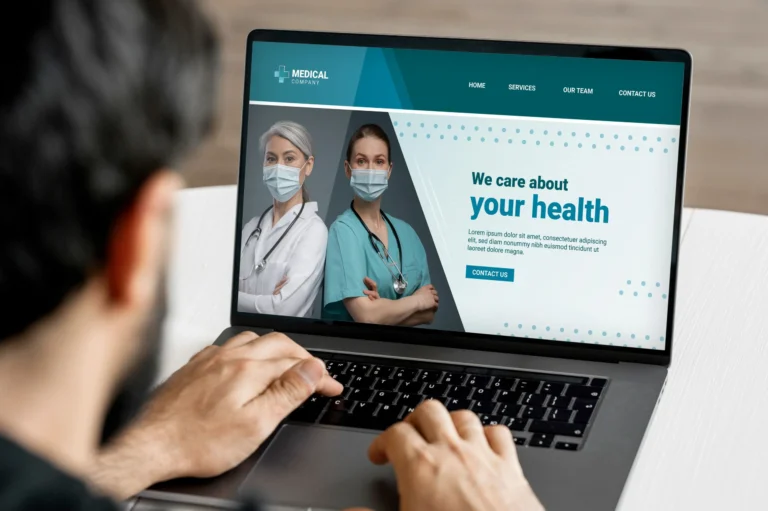
Sending healthcare PPC traffic to your clinic homepage is one of the most reliably budget-wasting decisions in medical advertising. The homepage is designed for general visitors — not for patients in active booking intent who just clicked an ad about a specific procedure.
What a high-converting healthcare PPC landing page must include:
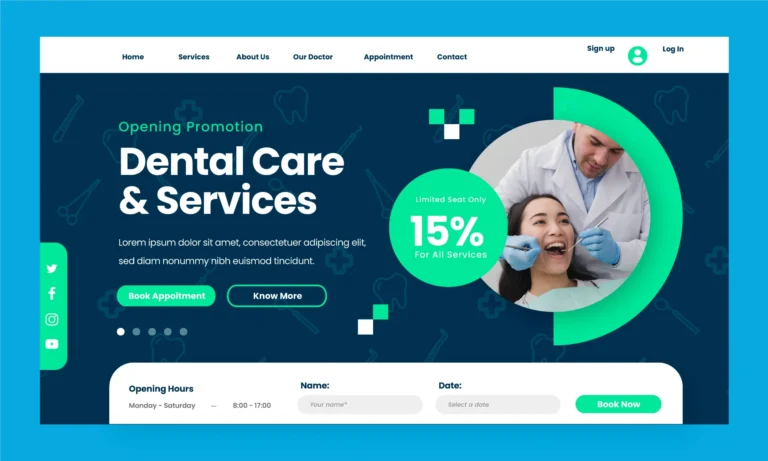
- A single, clear primary CTA — “Book an Appointment” or “Call Now” — visible above the fold without scrolling
- The specific procedure prominently featured in the headline — matching the patient’s search query
- Physician credentials, experience, and hospital affiliations — trust signals that reduce booking hesitation
- Patient reviews and testimonials specific to the featured procedure
- A simple 3-field contact form (name, phone number, preferred time) — friction reduction is critical on mobile
- A click-to-call phone number that works on mobile with one tap
Test one variable at a time: Headline variations, CTA button copy, and form length all measurably affect conversion rates. A/B testing even one element per month compounds significantly over a 12-month PPC campaign.
Strategy 3 — Use Negative Keywords to Eliminate Wasted Budget
Negative keywords prevent your healthcare PPC ads from showing for irrelevant searches — protecting your budget from clicks that will never convert into patients.
Build your negative keyword list immediately:
- “free” — eliminates searches for free medical care from budget-allocated campaigns
- “home remedy” — patients looking for self-treatment, not appointments
- “NHS” / “government hospital” — patients seeking public healthcare
- “jobs” / “careers” / “vacancy” — employment seekers, not patients
- Locations outside your catchment area — prevent wasting budget on patients who cannot realistically visit
Review your Search Terms report in Google Ads weekly — it shows exactly which patient searches triggered your ads, revealing new negative keywords to add and new positive keywords to target.
Strategy 4 — Implement Full Conversion Tracking Before Spending Anything
Running healthcare PPC without conversion tracking is the equivalent of running a clinic without keeping patient records — you are spending budget with no way to know what is working.
Conversion events to track for healthcare PPC:
- Phone call clicks from the landing page and ad extension
- Form submissions — appointment request, callback request, consultation booking
- Chat initiations — for clinics using live chat or WhatsApp integration
- Direction requests — for local campaigns
- Appointment confirmation page views — for clinics with online booking systems
Tools required:
- Google Tag Manager — to deploy tracking without developer dependency
- GA4 — for attribution and patient journey mapping
- Call tracking software (e.g., CallRail or Novocall) — to attribute inbound calls to specific keywords and ads
Without this data, you cannot reduce cost per patient acquisition over time — conversion tracking is the mechanism that makes every subsequent campaign iteration more efficient.
Strategy 5 — Use Ad Extensions to Maximise Click-Through Rate
Ad extensions expand your healthcare PPC ad with additional information — increasing the visual space your ad occupies on the search results page and providing patients with multiple ways to contact or engage with your practice.
Priority ad extensions for healthcare PPC:
- Call extensions — display your clinic phone number directly in the ad; patients can call without visiting the landing page
- Location extensions — show your clinic address and link to Google Maps directions
- Sitelink extensions — add links to specific services (Implants, Invisalign, Emergency, Fees), enabling patients to navigate directly to the relevant page
- Callout extensions — text snippets highlighting differentiators: “Same-Day Appointments,” “0% EMI Available,” “20+ Years Experience”
- Structured snippet extensions — list specific procedures offered: “Services: Knee Replacement, Hip Replacement, Arthroscopy”
Campaigns using all available relevant extensions consistently achieve 10-15% higher click-through rates than those using basic ads alone.
What Should a Healthcare PPC Strategy Include?
A complete healthcare PPC strategy — not just an ad campaign — contains:
- Keyword research and competitive analysis — understanding which keywords your competitors are bidding on and which terms have the best cost-to-conversion ratio
- Campaign structure — separate campaigns for each specialty or procedure, each with tightly themed ad groups
- Ad copy testing — a minimum of 3 ad variations per ad group testing different value propositions, CTAs, and benefits
- Landing page strategy — dedicated, conversion-optimised pages for each major campaign
- Bidding strategy — manual CPC in the first 60-90 days (until conversion data accumulates), then Smart Bidding toward conversion goals
- Monthly reporting — cost per lead, conversion rate, impression share, and Quality Score tracked and acted upon monthly
Healthcare PPC Costs in 2026
Understanding realistic cost expectations prevents under-investing in campaigns that need minimum scale to produce data, and over-investing before optimisation validates returns.
| Specialty / Market | Monthly Ad Budget | Estimated CPC | Estimated Cost Per Lead |
| General medicine — tier-2 city | ₹15,000 – ₹30,000 | ₹25 – ₹80 | ₹300 – ₹800 |
| Orthopaedics — metro city | ₹35,000 – ₹70,000 | ₹80 – ₹250 | ₹800 – ₹2,500 |
| Dental implants — metro city | ₹40,000 – ₹80,000 | ₹100 – ₹350 | ₹1,000 – ₹3,000 |
| LASIK / Eye surgery — metro | ₹30,000 – ₹60,000 | ₹70 – ₹200 | ₹700 – ₹2,000 |
| IVF / Fertility — metro | ₹50,000 – ₹1,00,000 | ₹150 – ₹500 | ₹2,000 – ₹5,000 |
Why healthcare PPC can be expensive: Medical keywords carry high commercial intent — a patient clicking a dental implant ad is near the bottom of the buying funnel. This intent commands a premium in Google’s auction system. The correct response is not to reduce budget but to improve landing page conversion rate — turning the same number of clicks into more bookings.
5 Common Healthcare PPC Mistakes to Avoid
Mistake 1 — Sending all traffic to the homepage
Every campaign needs a dedicated landing page matched to the specific procedure and search intent. Homepage traffic from PPC consistently converts at 2-4% vs 8-15% for well-optimised landing pages.
Mistake 2 — Running campaigns without conversion tracking
Without tracking, budget optimisation is impossible. Every healthcare PPC campaign must have call tracking and form tracking active before the first rupee is spent.
Mistake 3 — Ignoring the Search Terms report
Not reviewing which actual patient searches triggered your ads means wasting budget on irrelevant clicks. The Search Terms report is the most valuable weekly optimisation tool in Google Ads.
Mistake 4 — Setting budgets too low to be competitive
A ₹5,000/month healthcare PPC budget in a competitive metro specialty produces too few clicks to generate meaningful data — let alone appointments. Either commit to the minimum viable budget for your specialty or redirect to SEO while budget builds.
Mistake 5 — Stopping campaigns as soon as capacity fills
Patient enquiry volume fluctuates — stopping campaigns when appointment books fill prevents the data accumulation that makes future campaigns cheaper and more effective. Reduce bids instead of pausing.
Frequently Asked Questions
1. What is PPC in healthcare?
PPC is a paid advertising model where clinics and hospitals pay when users click their ads on platforms such as Google or Meta. It helps healthcare businesses reach people actively searching for relevant services.
2. Why is healthcare PPC so expensive?
Healthcare PPC can be expensive because medical keywords often have high commercial value and strong competition, especially in major cities. Optimised ads, relevant keywords, and high-converting landing pages can help improve cost efficiency.
3. How is PPC cost calculated in healthcare?
PPC cost is generally based on clicks × average CPC. A useful campaign metric is cost per lead, calculated by dividing total ad spend by the number of qualified enquiries or leads generated.
4. What are the 5 P’s of healthcare marketing?
The 5 P’s are Product, Price, Place, Promotion, and People. In healthcare, these cover medical services, pricing, accessibility, marketing channels, and the doctors and staff who shape the patient experience.
5. What is the best marketing strategy for healthcare?
A strong healthcare marketing strategy combines SEO for long-term organic visibility with PPC for faster, targeted reach. Together, they can improve visibility, generate qualified enquiries, and support sustainable patient acquisition.
Conclusion
Healthcare PPC is the most controllable, fastest-acting patient acquisition channel available to clinics and hospitals in 2026 — but only when structured correctly. Generic keywords, homepage traffic, and campaigns without conversion tracking consistently waste budget without generating appointments. The five strategies in this complete guide — procedure-specific targeting, dedicated landing pages, negative keywords, conversion tracking, and ad extensions — are the foundation of every high-performing healthcare PPC campaign.
Ocean Multivision — one of India’s leading healthcare marketing agencies — builds and manages healthcare PPC campaigns for hospitals, clinics, and specialist doctors across India, delivering transparent cost-per-patient reporting, conversion-optimised landing pages, and continuously improving campaigns that get measurably better over time.





One Response