

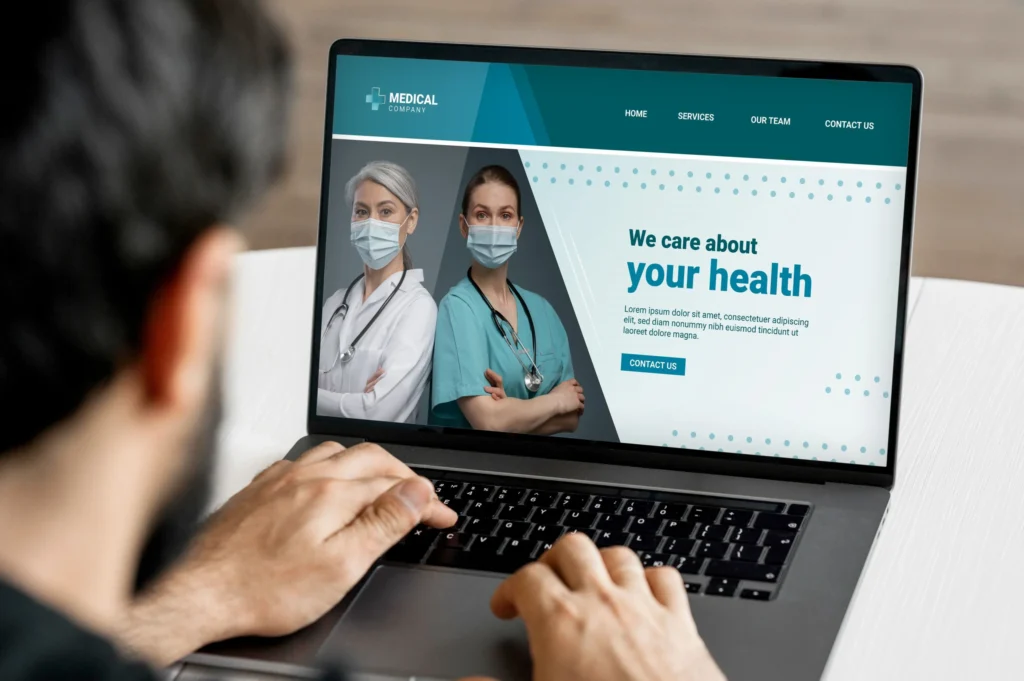
Your clinic may be excellent. Your patient outcomes may be outstanding. But if patients cannot find you online when they are actively searching for your specialty — they will book with someone else.
Google Ads for doctors is one of the fastest, most measurable ways to put your practice in front of patients at the exact moment they are searching for the care you provide. This complete guide explains how it works, why it is different for healthcare, and the five most effective strategies to generate consistent patient appointments.
How Do Google Ads for Doctors Actually Work?
Google Ads operates on a pay-per-click (PPC) model — you create ads that appear at the top of Google search results, and you pay only when someone clicks on your ad.
For doctors and clinics, the process works like this:
- A patient searches for something like “orthopaedic surgeon in Delhi” or “best gynaecologist near me”
- Google matches this search to relevant ads based on your chosen keywords and location settings
- Your ad appears at the very top of the results — above all organic (unpaid) listings
- The patient clicks your ad and lands on your appointment page
- You pay only for that click — not for the impression
The key advantage is intent. Patients using Google to search for medical services are not casually browsing — they have a problem, and they are actively looking for a solution. Google Ads puts you directly in front of them at that decision-making moment.
Why Google Ads Works Differently for Doctors
Running Google Ads for a medical practice is not the same as running ads for an e-commerce store or a restaurant. Healthcare advertising has specific requirements, sensitivities, and compliance considerations that directly influence how campaigns must be structured.
Google’s healthcare advertising policies restrict:
- Making specific medical claims that cannot be substantiated
- Certain types of pharmaceutical and treatment advertising in some regions
- Misleading content about medical outcomes or guarantees
What makes healthcare campaigns different:
- The conversion goal is an appointment or enquiry — not an impulse purchase
- Patient trust must be established within seconds of clicking the ad
- Landing pages must be credible, fast-loading, and clinically professional
- Keywords are often highly competitive and expensive — requiring careful targeting to avoid wasting budget
- HIPAA and data privacy considerations affect how leads can be tracked and followed up
A common digital marketing agency running standard retail ad campaigns on a medical practice account will almost always result in poor performance and wasted budget. Healthcare-specific knowledge is not optional — it is essential.
Traditional Doctor Marketing vs. Google Ads
For decades, doctors relied on referrals, word of mouth, newspaper listings, and physical hoardings to attract new patients. These channels still have value — but they have significant limitations compared to Google Ads.
| Traditional Marketing | Google Ads | |
| Speed | Months to see results | Can generate enquiries within days |
| Targeting | Broad, geographic only | Specific by keyword, location, device, time |
| Measurability | Very difficult to track | Every click, call, and form tracked precisely |
| Cost control | Fixed spend regardless of results | Pay only when someone clicks |
| Patient intent | Passive — interrupts uninterested audience | Active — reaches patients already searching |
| Adjustability | Cannot change mid-campaign | Can be paused, adjusted, and scaled in real time |
For doctors who need a consistent, measurable patient pipeline — Google Ads delivers what traditional marketing simply cannot.
The 5 Best Google Ads Strategies for Doctors
1. Target High-Intent, Treatment-Specific Keywords
The most effective Google Ads campaigns for doctors target keywords that reflect specific patient intent — not just broad medical terms.
High-intent examples:
- “knee replacement surgeon in [city]”
- “IVF consultation [city]”
- “dentist open now near me”
- “best dermatologist for acne [city]”
Avoid overly broad keywords like “doctor” or “hospital” — they attract irrelevant clicks, inflate costs, and produce almost no appointments. Use phrase match and exact match keyword types to keep your ads reaching the most relevant searches.
Negative keywords are equally important. Adding terms like “free,” “salary,” “jobs,” “home remedies,” and “DIY” to your negative keyword list stops your budget from being wasted on searches with no appointment intent.
2. Write Ad Copy That Builds Instant Trust
Patients searching for medical care want to feel immediately confident they have found the right provider. Your ad copy has approximately 2–3 seconds to communicate that confidence.
Effective healthcare ad copy includes:
- The doctor’s name and qualification (e.g., “MS Ortho, 20 Years’ Experience”)
- Specific specialisation rather than a generic claim (“Spine Surgery Specialist” not “Best Doctor”)
- A clear, specific call to action (“Book a Consultation Today” or “Call Now — Same Day Appointments Available”)
- Trust signals within character limits — review ratings, certifications, or years of practice
Avoid superlatives like “best” or “top-rated” without substantiation — Google’s policies and patient trust both require credible, specific claims.
3. Build Landing Pages That Convert Patients
This is where most medical Google Ads campaigns fail. Sending paid traffic to your general homepage is one of the most common — and most expensive — mistakes a hospital can make.
Every campaign needs a dedicated landing page that includes:
- A clear, benefit-led headline matching what the patient searched
- Doctor credentials visible above the fold — photo, qualifications, hospital affiliation
- A short, simple appointment booking form with minimal required fields
- Patient testimonials or Google review ratings
- A prominent phone number — click-to-call on mobile
- Page load speed under 3 seconds — slow landing pages directly increase your cost-per-lead
The landing page is where clicks become appointments. Investment in landing page quality produces a direct return in conversion rate.
4. Use Location and Schedule Targeting Precisely
Most medical practices serve a defined geographic area. Paying for clicks from patients 100 kilometres away who will never attend your clinic is wasted budget.
Location targeting best practices:
- Set radius targeting around your clinic location — typically 5–15km depending on specialty
- For rare or highly specialised services, wider radius targeting is justified
- Exclude specific areas where your clinic does not serve patients
Ad scheduling:
- Run ads during the hours your appointment desk or booking system is active
- Increase bids during peak search hours — typically 8–10 am and 7–9 pm for most healthcare queries
- Pause ads outside clinic hours unless you have an automated booking system that captures enquiries 24/7
5. Track Every Call, Form, and Appointment
Google Ads without conversion tracking is like running a clinic without keeping patient records — you have no way of knowing what is working.
Set up tracking for:
- Phone call tracking — Google’s call extensions and call tracking numbers show exactly which ads generated phone calls
- Form submissions — every enquiry form completion tracked as a conversion in Google Ads
- Appointment bookings — if your clinic uses an online booking system, track completed bookings as your primary conversion goal
- Google Analytics 4 linked to your Google Ads account for full user journey visibility
With proper tracking, you know your cost-per-appointment, your best-performing keywords, and exactly where to invest more budget for growth.
Google Ads Mistakes That Drain Your Budget
Even well-intentioned campaigns can waste a lot of budget without these common mistakes being caught early:
- Using broad match keywords without negative keywords — your ads appear for completely irrelevant searches
- Sending traffic to the homepage — patients arrive with no clear path to book an appointment
- Ignoring Quality Score — low Quality Score means you pay more per click than competitors with better-optimised ads
- No call tracking — you have no idea how many patients are calling directly from your ads
- Setting a budget and forgetting — Google Ads requires active weekly monitoring and optimisation, not a set-and-leave approach
- Not testing ad variations — running only one version of your ad means never discovering what copy generates more appointments
- Bidding on competitor names — usually expensive and produces low-quality clicks from patients already committed to another provider
Benefits of Google Ads for Doctors
For doctors who implement campaigns correctly, Google Ads delivers advantages no other marketing channel can match at the same speed:
- Immediate visibility — appear at the top of Google within hours of launching, not months
- Pay only for genuine interest — every click is from a patient who actively searched for your service
- Measurable patient acquisition cost — know exactly what each new patient appointment is costing you
- Complete budget control — set daily and monthly spend limits; pause instantly if needed
- Specialty-specific targeting — reach patients searching for your exact procedure or condition, not just “doctor”
- Scalable growth — increase budget when campaigns are profitable; scale back during quieter periods
- Complements SEO — while SEO builds long-term organic authority, Google Ads delivers sudden results during the months it takes for organic rankings to develop
Frequently Asked Questions
1. Are doctors allowed to advertise?
Yes — doctors and medical practices can legally advertise in India and most countries worldwide, including through Google Ads. Advertising must comply with Google’s healthcare policies, avoid unverifiable medical claims, and follow relevant medical council advertising guidelines in your region.
2. How long does it take to get new patients from Google Ads?
Well-structured campaigns typically begin generating patient enquiries and calls within the first 1–2 weeks of launch. Meaningful, consistent appointment volume usually develops within 4–8 weeks as campaigns are optimised based on real performance data.
3. What is the biggest mistake clinics make with Google Ads?
Sending paid traffic to a generic homepage instead of a dedicated, conversion-optimised landing page. This single mistake is responsible for the majority of wasted Google Ads budget in healthcare campaigns — enquiries that never convert because the patient has no clear path to book.
4. Why use Google Ads if we already do SEO?
SEO builds long-term organic visibility — but typically takes 3–6 months to show meaningful results. Google Ads delivers immediate top-of-page presence while SEO develops. The two work best together: ads fill appointments now while SEO builds sustainable organic growth for the future.
5. Are Google Ads or Facebook Ads better for getting new patients?
Google Ads consistently outperforms Facebook Ads for direct patient appointment generation because it targets active intent — patients already searching for your service. Facebook Ads are more effective for awareness and remarketing. For most clinics, Google Ads should be the primary paid channel, with Facebook used to support and retarget.
Conclusion
Google Ads for doctors — when built and managed correctly — is one of the most powerful patient acquisition tools available to any medical practice. It reaches patients at the accurate moment they are ready to book, delivers measurable results from day one, and scales directly with your growth ambitions.
The difference between campaigns that consistently fill appointment books and those that drain budgets without results comes down to one thing: healthcare-specific expertise.
Ocean Multivision — one of India’s leading healthcare marketing agencies — specialises in building and managing Google Ads campaigns exclusively for hospitals, clinics, and specialist doctors. With deep knowledge of healthcare compliance, patient behaviour, and campaign optimisation, we deliver the patient appointments your practice needs — at a cost you can measure and justify.




4 Responses