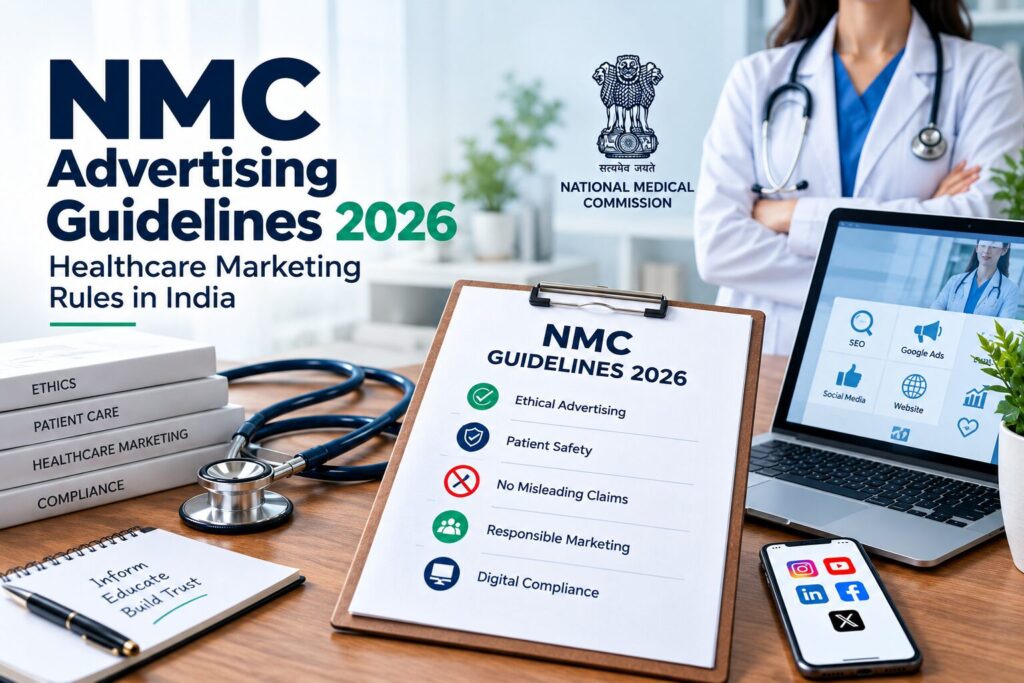
The National Medical Commission (NMC) published its Guidelines on Ethical Advertising and Public Communication by Hospitals/Medical Institutions and Registered Medical Practitioners on 6 October 2026. These guidelines are crucial for doctors, hospitals, clinics, and healthcare marketing professionals who create or publish medical content online. Read the official NMC notice.
Understanding the NMC Advertising Guidelines is important before publishing promotional content, running campaigns, or updating a healthcare website. The rules address how medical professionals and institutions communicate with the public, including restrictions on misleading claims, endorsements, and promotional practices.
What Are the NMC Advertising Guidelines?
The National Medical Commission (NMC), India’s apex medical regulatory body, replaced the Medical Council of India (MCI) in 2020. It oversees the professional conduct of registered medical practitioners, including how they communicate and promote their services to the public.
NMC regulations on professional conduct and ethics, including advertising restrictions, draw on the Indian Medical Council (Professional Conduct, Etiquette and Ethics) Regulations, 2002, within the NMC framework. These rules aim to prevent misleading, unprofessional, or exploitative practices, particularly where patients may be vulnerable.
In 2026, the growth of digital healthcare marketing—including Google Ads, social media, influencer partnerships, AI-generated content, and SEO—has made understanding how these guidelines apply online increasingly crucial for healthcare providers and marketing agencies.
What Are the Latest NMC Guidelines for Healthcare Marketing?
The NMC advertising guidelines establish that registered medical practitioners should not solicit patients directly or indirectly. The key principles that govern all healthcare marketing in India under the NMC framework are:
- No self-solicitation — doctors should not use paid advertising to actively solicit patients
- No false or misleading claims — guaranteed outcomes, cure claims, and comparative superiority statements are prohibited
- No use of prohibited titles — words implying exclusive expertise or superiority not supported by recognised qualifications
- No testimonials — patient testimonials endorsing a doctor’s services are not permitted in professional advertising
- Factual information only — communications must be factual, verifiable, and not designed to create unrealistic expectations
The spirit of the NMC guidelines is to protect patients — who are in a position of inherent vulnerability — from being exploited by aggressive or misleading medical marketing.
What Healthcare Advertising Practices Are Restricted?
The NMC guidelines specifically restrict or prohibit the following marketing practices:
Prohibited in all formats (digital, print, broadcast):
- Claiming to be “the best,” “number one,” “most experienced,” or “top-ranked” without objective, verifiable evidence
- Guaranteed outcomes — “guaranteed cure,” “100% success rate,” “no failure cases”
- Before-and-after photographs implying guaranteed cosmetic or surgical outcomes
- Paid patient testimonials and fabricated reviews
- Comparative advertising denigrating other doctors or hospitals
- Use of titles, degrees, or fellowships not recognised by the NMC or equivalent bodies
- Advertising services through channels that exploit patient anxiety or urgency
Restricted on digital platforms:
- Sponsored “expert” content that does not disclose its commercial nature
- Paid influencer partnerships without clear commercial disclosure
- AI-generated patient testimonials or fabricated case studies presented as real
- Rankings or certifications from unrecognised entities used as credibility claims
Words to Delete from Your Bios, Ads, and Website Today
If you are a doctor or hospital administrator, audit your digital presence immediately for these non-compliant phrases:
Delete immediately:
- “Best doctor in [city]” — superlative claims without NMC-recognised basis
- “No. 1 surgeon in India” — unverifiable ranking claim
- “Guaranteed results” / “100% cure rate” — outcome guarantees
- “Most experienced” — relative claim without verifiable supporting data
- “India’s top specialist” — superlative without recognised basis
- “Trusted by millions” — unless auditable patient data supports this
- “Award-winning” — only permissible if the award is from a legitimate, recognised body with transparent selection criteria
Use instead:
- Factual qualification statements: “MBBS, MS (Orthopaedics), AIIMS Delhi”
- Experience stated factually: “15 years of clinical experience in joint replacement surgery”
- Honest volume data: “Performed over 2,000 hip replacement procedures”
- Institutional affiliations: “Senior Consultant, XYZ Hospital, New Delhi”
What Healthcare Marketing Activities Are Still Permitted?
The NMC advertising guidelines do not prohibit all marketing — they restrict misleading and exploitative marketing. The following activities are broadly compliant when executed accurately and ethically:
Permitted digital marketing activities:
- Factual website content — listing qualifications, services offered, hospital affiliations, and clinic locations
- Educational health content — blog posts, videos, and social media content that educates patients about conditions, treatments, and prevention — without promoting the doctor directly
- Google Business Profile (GBP) — maintaining a complete, accurate GBP listing with genuine patient reviews
- Organic Google reviews — authentic patient reviews not solicited through incentives
- Healthcare SEO — optimising factual, educational content to rank in search results
- Condition and procedure information — detailed explanations of medical conditions and available treatment options
- Speaking engagements and conference presence — promoting genuine academic and professional activity
- Hospital and clinic branding — institutional identity marketing that does not make prohibited claims
How Do the NMC Guidelines Affect Healthcare SEO?
Healthcare SEO — the process of optimising a doctor’s or hospital’s website to rank on Google — is largely unaffected by NMC guidelines when done correctly, because it operates through educational content rather than direct solicitation.
Compliant healthcare SEO practices:
- Ranking for informational keywords — “what is a herniated disc,” “cataract surgery recovery time” — through educational, physician-attributed content
- EEAT-compliant content — physician name, qualifications, and experience clearly attributed to all medical content
- Location-based service pages — “orthopaedic surgeon in Noida” — provided content is factual and makes no prohibited claims
- Internal linking between educational content and factual service pages
Non-compliant SEO elements to correct:
- Title tags and meta descriptions using superlatives — “Best Orthopaedic Doctor in Delhi”
- Schema markup claiming awards or rankings from unrecognised bodies
- Content making outcome guarantees — “our surgery guarantees full recovery”
- Fabricated patient case studies presented as factual
The NMC guidelines do not prohibit ranking on Google — they prohibit the use of misleading claims in the content that ranks.
What Do the NMC Guidelines Mean for Social Media Marketing?
Social media is the most complex area of NMC compliance in 2026 — because the informal, personal nature of platforms like Instagram and YouTube creates the most frequent unintentional violations:
Permitted on social media:
- Educational posts about medical conditions, treatments, and prevention
- Factual “about the doctor” biographical content
- Patient education reels and videos — without testimonial structure
- Health awareness campaigns aligned with national health observances
- Sharing peer-reviewed research and clinical guidelines
Non-compliant social media content:
- Patient testimonial videos — even if genuine and unpaid
- “Transformation” before-and-after reels with implied outcome guarantees
- Superlative claims in captions — “Best cosmetic surgeon in Mumbai”
- Paid partnerships with non-medical influencers promoting clinical services
- AI-generated “patient stories” presented as real cases
Are Google Business Profile and Online Reviews Affected?
Google Business Profile (GBP) is permitted and encouraged under NMC guidelines — it helps patients find accurate, factual information about a clinic or hospital.
Compliant GBP practices:
- Complete, accurate clinic information — address, hours, specialities, contact details
- Genuine patient reviews submitted voluntarily — the NMC does not prohibit organic patient feedback
- Responding professionally to reviews — including negative ones
Non-compliant GBP practices:
- Incentivising patients to leave positive reviews — gift cards, discounts, or free follow-up consultations in exchange for reviews
- Fabricating reviews through staff, family, or purchased review services
- Business descriptions using superlative or prohibited claim language
How Do the NMC Guidelines Affect Google and Meta Ads?
This is the area of greatest NMC compliance uncertainty for healthcare providers in 2026 — because paid digital advertising is the closest activity to the “solicitation” the guidelines restrict.
The current practical interpretation: The NMC guidelines were written in a pre-digital context and do not explicitly address Google Ads or Meta Ads. However, the principle that doctors should not actively solicit patients through advertising has been broadly interpreted to restrict paid advertising that directly promotes clinical services.
The practical compliance approach used by compliant healthcare marketers:
- Hospitals (not individual doctors) — institutional advertising by hospitals and clinics is more clearly permissible than individual doctor advertising
- Factual, non-solicitation language — ads that provide factual information (“Orthopaedic OPD Available, Monday-Saturday”) rather than direct solicitation (“Book Surgery Now — Best Results Guaranteed”)
- No prohibited claims in ad copy — no superlatives, no outcome guarantees, no unverifiable rankings
- Educational intent framing — ads that drive traffic to educational content are less directly soliciting than ads that drive to a “book now” page
AI in Healthcare Marketing — What You Can and Can’t Do
AI-generated content in healthcare marketing raises specific NMC compliance questions:
Permitted AI use in healthcare marketing:
- AI-assisted drafting of educational content — reviewed and approved by the physician before publication
- AI tools for SEO research and content planning
- AI-powered chatbots that provide factual information and appointment booking assistance
- AI analysis of marketing performance data
Non-compliant AI use in healthcare marketing:
- AI-generated patient testimonials or fabricated case studies
- AI-generated physician personas presenting fabricated medical opinions
- AI content published without physician review or attribution — violating EEAT requirements
- AI tools generating superlative or outcome-guarantee language that is then published unchanged
The rule: AI can assist human healthcare marketers — it cannot replace the physician attribution and factual accuracy that NMC compliance and EEAT both require.
The Penalty Ladder — NMC Violations and Consequences
Understanding the consequences of NMC advertising violations helps contextualise the importance of compliance:
Warning and advisory stage: The State Medical Council issues a formal warning for a first-time, minor violation — such as a superlative claim in a directory listing.
Erasure from the register: Serious or repeated violations of professional conduct regulations — including systematic misleading advertising, fabricated credentials, or commercial exploitation of patients — can result in temporary or permanent removal from the NMC register.
Consumer Protection Act liability: In addition to NMC consequences, misleading healthcare advertising can trigger complaints under the Consumer Protection Act, 2019 — with financial liability for false or misleading claims causing patient harm.
ASCI and MIB referrals: The Advertising Standards Council of India (ASCI) and the Ministry of Information and Broadcasting (MIB) are increasingly active in referring non-compliant healthcare advertisements for regulatory action — particularly for digital and broadcast media.
Healthcare Marketing Compliance Checklist for Doctors and Hospitals
Use this checklist to audit your current digital presence for NMC compliance:
Website:
- ☐ No superlative claims (“best,” “number one,” “top”) without verifiable basis
- ☐ All qualifications listed are NMC-recognised
- ☐ No outcome guarantees or cure claims
- ☐ No fabricated patient testimonials
- ☐ All content attributed to named, qualified physicians
Google Business Profile:
- ☐ Business description free of prohibited claims
- ☐ No incentivised reviews
- ☐ Review responses professional and factual
Social Media:
- ☐ No before-and-after content implying guaranteed outcomes
- ☐ No patient testimonial videos or posts
- ☐ Educational content attributed to the doctor
- ☐ No paid influencer partnerships for clinical services
Google and Meta Ads:
- ☐ No superlatives in ad headlines or descriptions
- ☐ No outcome guarantees in ad copy
- ☐ Factual, institutional language rather than direct solicitation
Frequently Asked Questions
1. Are hospitals allowed to advertise in India?
Hospitals can communicate factual information about their services, facilities, specialities, and contact details, subject to applicable NMC guidelines and advertising codes. Misleading claims, guaranteed outcomes, and unsupported superlatives may violate the relevant rules.
2. What is not allowed in healthcare advertising in India?
Restricted practices may include guaranteed outcomes, unsupported claims such as “best” or “number one,” prohibited patient testimonials, misleading comparisons with other doctors, and unrecognised qualifications used to mislead patients.
3. Can a doctor run Google Ads in India?
Doctors should not assume that individual Google Ads are automatically permitted. The proposed campaign must be assessed against applicable NMC requirements, including restrictions on solicitation and third-party marketing. Factual wording alone does not guarantee compliance.
4. Can doctors use Instagram and YouTube for marketing?
Doctors can use social platforms for appropriate professional communication and health education, subject to applicable rules. Educational videos and awareness posts should be factual, while testimonials, promotional before-and-after content, and guaranteed outcomes require careful compliance review.
5. Are patient testimonials allowed in India’s healthcare advertising?
The NMC guidelines restrict patient testimonials and endorsements used for professional promotion. Genuine, unsolicited patient reviews may differ from testimonials actively requested or republished for advertising, so their use should be assessed carefully.
6. Can AI-generated content be used in healthcare marketing?
AI can assist with content creation, but medical information must be verified and reviewed appropriately. Fabricated patient stories, misleading claims, and synthetic endorsements can create serious compliance concerns. Follow applicable attribution and disclosure requirements.
7. What does “EEAT” mean in healthcare SEO and marketing?
EEAT stands for Experience, Expertise, Authoritativeness, and Trustworthiness. In healthcare SEO, it supports reliable, accurate content with clear authorship and credible sources. These principles complement ethical medical communication but do not replace regulatory compliance.
8. What words are prohibited in healthcare advertising in India?
Words such as “guaranteed cure,” “100% success,” and “number one” can be problematic when misleading or unsupported. Claims about superiority, experience, qualifications, and certifications should be accurate, verifiable, and consistent with applicable NMC requirements.
9. Can healthcare providers use before-and-after photos in India?
Before-and-after photographs used for healthcare promotion may be restricted under applicable NMC guidelines and advertising codes. Clinical documentation and educational use should be distinguished from promotional imagery that implies guaranteed results or creates unrealistic expectations.
10. What are the NMC penalties for advertising violations in India?
Consequences depend on the applicable provisions, the nature of the violation, and the disciplinary process. They may include warnings or other professional disciplinary measures, potentially extending to suspension or removal from the medical register in serious cases. Other laws may apply separately.
Conclusion
NMC Advertising Guidelines 2026 do not necessarily prevent healthcare providers from building a strong digital presence. They define boundaries for ethical communication, making correct health content, factual service information, and trustworthy physician profiles essential to responsible healthcare marketing.
The risk is not marketing itself, but misleading or incorrect claims and practices that compromise patient trust. Healthcare providers should review their digital strategies against the applicable guidelines before publishing content or launching campaigns.
Ocean Multivision, a healthcare marketing agency in India, helps hospitals, clinics, and specialist doctors strengthen their digital presence through SEO, content marketing, paid campaigns, and social media strategies. Our focus is on building effective digital strategies while prioritising accuracy, transparency, and applicable healthcare advertising requirements.